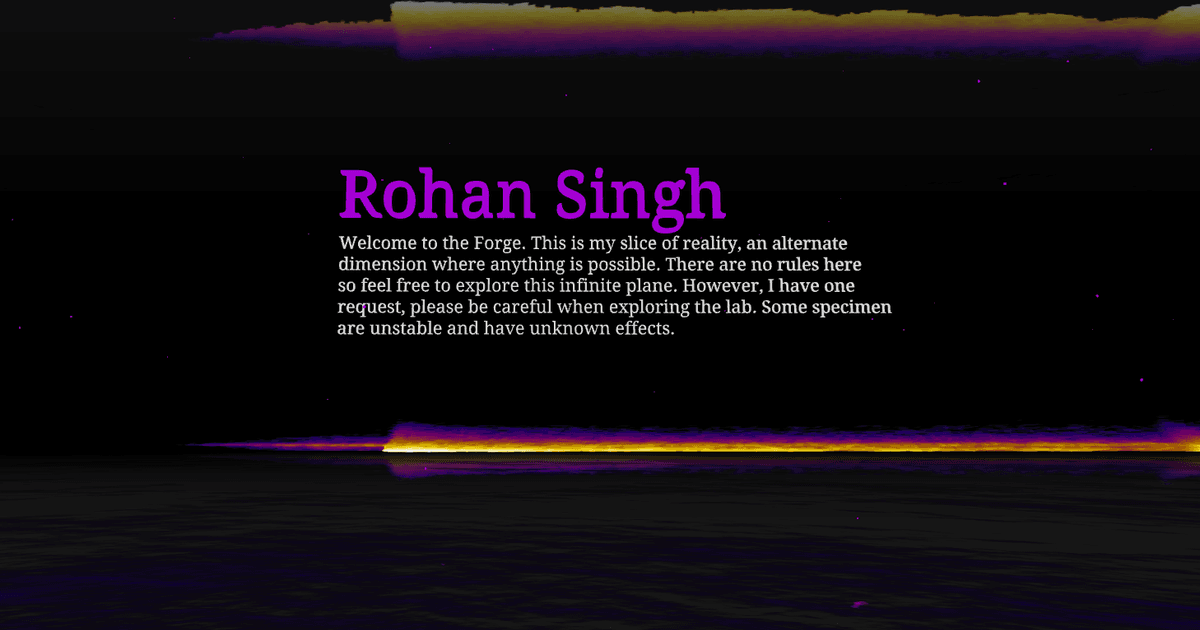
The Forge was my first real three.js project and my first personal website. Instead of a page you scroll, it drops you into a dark world you walk around in first person, with the sections of the site (home, about, experience, labs) floating as 3D text. I built it in Vue 3 and three.js (r146) over November and December 2022, mostly to teach myself how a WebGL scene actually works: geometry buffers, custom shaders, audio, and cleaning up after yourself.
The Audio Spectrogram
The centerpiece is a scrolling 3D spectrogram that surrounds the world on four sides.
- Geometry. I build a grid mesh by hand in a
BufferGeometry: 256 frequency bins by 400 time samples, about 100,000 vertices. The frequency axis is log-spaced, so the low end, where most of the music’s energy is, gets more of the mesh. - Audio. When you press start, the track plays through an
AnalyserNodewith an FFT size of 1024 and a smoothing constant of 0.5. Every frame I read the 256 byte-valued frequency bins. - Scrolling. The mesh carries a per-vertex
displacementattribute. Each frame I shift the whole history back by one row withcopyWithinand write the newest spectrum into the front row, so time flows across the surface without rebuilding any geometry. - Shading. A small custom
ShaderMaterialdoes the rest. The vertex shader pushes each vertex out along its normal by its displacement and uses the same value to index a 256-entry color lookup table (the “electric” colormap) passed in as a uniform array. The fragment shader just writes that color.
The result is a wall of sound you can walk along, where the shape and the color both come straight from the FFT.
The World Around It
- Water and sky. three’s
Waterobject gives a reflective, animated ocean with scrolling normal maps, mirrored by a second dark water plane overhead, under aSkyshader set to a dim sun. Distance fog hides the edges. - Metaballs. A
MarchingCubesfield of 50 animated blobs bobs above the water. - Objects and particles. Rotating torus rings form a boundary, a torus knot and cube float in the middle, and a particle field drifts overhead.
- Positional audio. The track also plays as a three.js
PositionalAudiosource attached to a sphere at the origin, so it gets louder as you walk toward the center. - Navigation.
FirstPersonControlswith clamped look angles and height, plus a soft boundary that teleports you back to the start if you wander off the map.
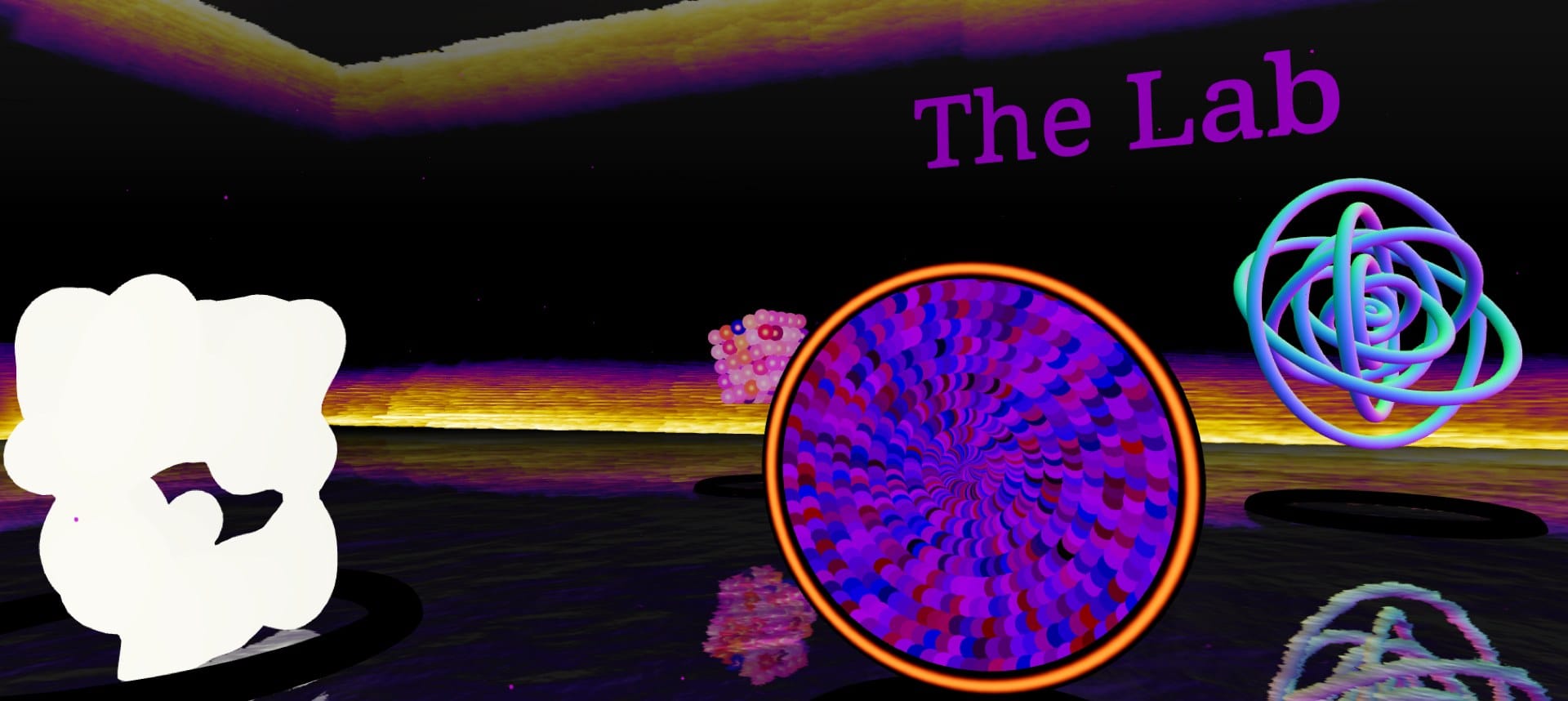
The Portal and the Factory
Walking into the glowing portal stops the audio, disposes every geometry, material and texture in the scene, checks through renderer.info that nothing is left on the GPU, and only then switches to a second scene. Getting that teardown right was the most useful thing I learned on the project: three.js does not free GPU memory for you.
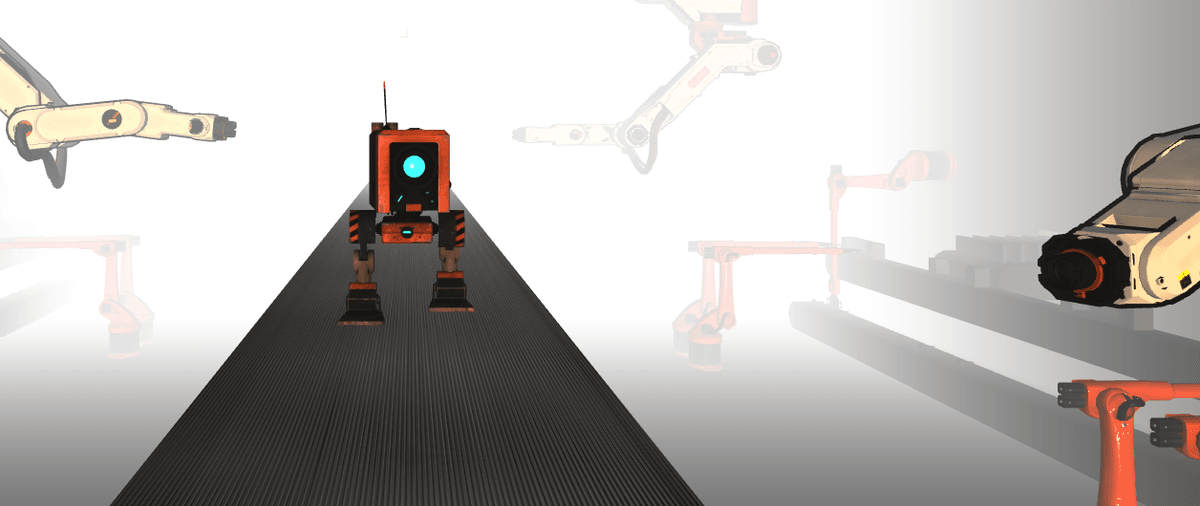
The second scene, the Factory, is bright where the first is dark. A camera follows a path past a conveyor belt and an animated robot arm loaded from GLTF, with purple sparks and six panels of 3D text that tell my background at the time, from mechanical engineering to my software internship at Tesla.
Looking Back
The Forge is rough in places. It renders on a fixed timer instead of the display refresh, and walking around in first person is a lot to ask of someone who just wants to read a resume. But it taught me the parts of graphics programming I still use: building geometry directly in buffers, moving data to the GPU through attributes and uniforms instead of rebuilding meshes, and owning resource cleanup. The code is on GitHub. The old demo deployment is no longer live.