Almost every piece of co-founder advice I have read was written backwards. Someone picks a partner, the company works or it does not, and the reasoning gets assembled afterward to explain the outcome. Chemistry. Complementary skills. Shared values. The words are all fine. They are also unfalsifiable, and they arrive too late to help anyone who is actually choosing.
So I want to write this the other way around, out of the things that exist in writing rather than the things I remember feeling.
Paul Grech and I met at Carnegie Mellon, founded OctaPulse in 2025, and went through Y Combinator’s Winter 2026 batch as a team of two, working out of Pittsburgh. That is the entire founding record, and I am going to leave it there.
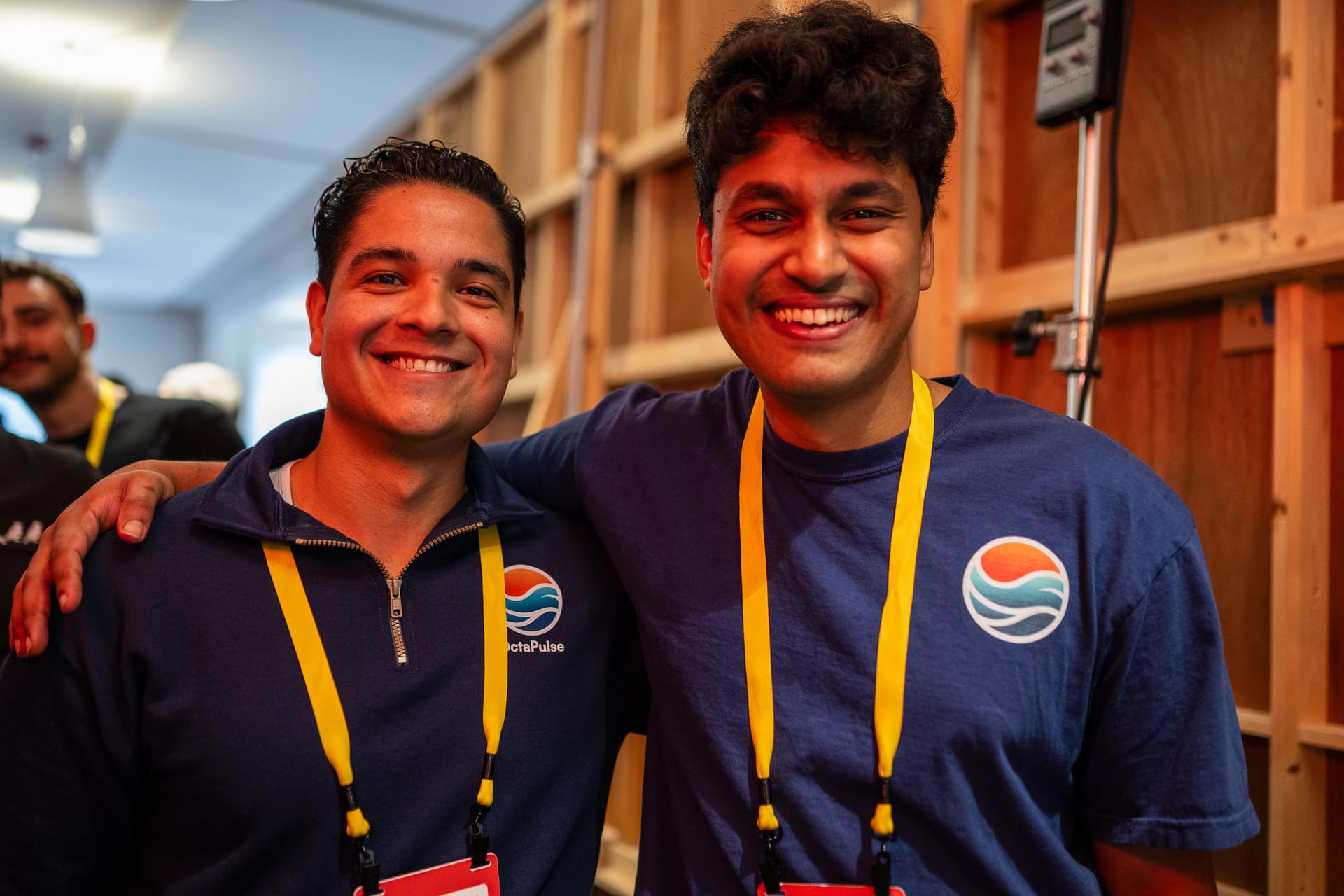
The origin story is the least useful part of the answer
People ask how we met the way you ask for a recipe, as though the answer is portable. It is not. I am also not going to reconstruct it, because any version I told you now would be assembled after the fact, and I would be doing exactly the thing I said I was tired of reading.
What is portable is everything that came afterward: the specific things two people decided to make explicit, and the specific things they decided to stop arguing about by writing them down once.
That is the actual subject here. Not how you find a co-founder. What you build between you once you have one.
The failure that taught me the most was not a technical one
I have two prior attempts on record, and they failed in different directions.
The first was Quaternion Studios, which I ran alone. Solo, you are the only variable. Everything that goes wrong is yours, which is clarifying and also a trap, because you never find out which parts of the job you are bad at. There is nobody standing next to you doing them better.
The second was a construction bidding and change request startup I applied to Y Combinator with in the Summer 2024 batch, alongside two friends, Dominic and Prathik. Prathik secured our first beta user by striking up a conversation with a general contractor on a live construction site. We were interviewed twice in the same batch, which as far as I know is not common, and we were rejected.
I wrote my post-mortem at the time and I still stand by it. We failed to explain the problem and the value clearly, and we were unprepared on pricing, customer acquisition and go-to-market. Not one of those is an engineering failure. There were three of us and a demo, and the half of the company that sank us was the half none of us had prepared for.
That is the most useful input I have ever had to a co-founder decision, and it cost two interviews and a rejection to acquire.
I have written before that I underestimated how much the team matters, and that when you are running a side project alone you are the only variable. I want to sharpen that now, because “get a co-founder” is not the correction. The correction is to find out, in advance and specifically, which half of the company you are unable to hold, and then to stop pretending you will learn it on the way.
The clearest agreement we have is about what we say in public
The thing I would point to if someone asked what our co-founder relationship actually consists of is not a memory. It is a file in a repository: our voice and tone guide, which is the one reference for how OctaPulse sounds in public and how each of us writes under our own byline.
It assigns topics. Under my name it lists the tech, the industry-development read, and the engineering half of one shared pillar: computer vision, robotics, phenotyping, the measurement stack. Under Paul’s it lists commercial, industry, partnerships and mission, plus the operating side of that same shared pillar. So far that is just a beat sheet, and beat sheets are cheap.
The load-bearing part is the clause underneath each name, the one that begins with “Never”. Mine says no markety superlatives, and never claiming precision the system does not have: where we have a headline accuracy figure and a lower figure that holds at operating speed, I keep those two distinct rather than blurring them into one. Paul’s says no technical claims he cannot back, and route deep-tech specifics to me.
Those are the sentences that do work. Anyone can agree on who writes about what. The interesting agreement is about what each of you will refuse to say inside your own territory, because that is the promise the other person is relying on when they are not in the room.
An understanding about that which exists only in two people’s heads is not an agreement. It is a preference, and preferences dissolve under load. Ours survives because it is checked into a repository where either of us can point at it.
Complementary is not the same as non-overlapping
I want to be careful not to make this sound cleaner than it is.
On any given week I am writing vision models, specifying enclosures, debugging a camera that fell off a network in a plant I am not standing in, reading genetics literature, arguing about gripper compliance, talking to farmers who have run raceways longer than I have been alive, fundraising, and hiring. Several of those sit squarely on Paul’s side of any line you could draw. He is doing the mirror image of it.
That overlap is exactly why the written version matters. The guide does not say Paul never touches the technical story or that I never talk to a customer. It says who owns a claim and who defers on it.
Ownership does not mean only one person touches a thing. In a company of two, both people touch everything eventually. Ownership means one person decides, and the other person does not relitigate it three weeks later when it is inconvenient. That is the whole mechanism, and it only works if you have named the owner before the disagreement rather than during it.
The strongest alignment test is what you both refuse to say
The company keeps an internal proof-point dossier, the source of truth for anyone writing on OctaPulse’s behalf. Every number in it is labelled by how well it is supported: marketing positioning on one side, measured result on the other, with an instruction not to blur the two and not to invent or extrapolate a figure that is not already in the file. Our softest cost claim sits there labelled as positioning rather than a measured result.
I find that more reassuring than any conversation about values. A skills mismatch between co-founders is survivable, and honestly it is the point. A mismatch in what the two of you are willing to claim in public is not survivable, because it does not surface as a disagreement. It surfaces as one person quietly discovering that a number they are responsible for defending has already been said on a stage by the other one.
Writing down where the softest claim sits is a small act. It matters because it puts the standard somewhere outside whoever happens to be speaking that day.
The editorial line is the industry, never the team
There is one more decision I would put in this category, and it is an editorial one.
We had a content pillar called Founders and Building in Public. It was retired, and the comment left in the code where that decision lives reads: the editorial line is the industry, never the team. Our own traction, awards included, is treated as supporting evidence for a claim about the industry rather than as the subject of a post. A narrower first-person pillar about building this thing came back later for one platform only, tagged in a different colour precisely because it is the one pillar whose validity depends on where it is posted.
I am aware of the irony of writing that in an essay about the two of us. This is my personal site and the contract here is different. But the company default stands, and I think it is the correct one for a two-person team, because a company of two is very easy to accidentally turn into a story about two people. The work is not about us. Nobody buys a measurement system because the founders get along.
What I am not going to tell you
I do not have a co-founder war story. There is no argument I can reconstruct, no near-breakup, no reconciliation scene. I know that is the shape this genre usually takes, and I am not going to manufacture one to fill it.
What I have instead is a line I wrote about my own week, which is that I am trying to be a good co-founder to Paul while both of us are doing this at the same intensity.
I keep coming back to how that is phrased. Trying. It is a verb, and it appears in a list next to debugging cameras and reading genetics papers, which is exactly right. Being a good co-founder is not a state you achieve at the start by picking correctly. It is ongoing work that competes for time with everything else, and it loses that competition on a lot of days.
So if I were compressing this into advice, it would not be about finding the right person. It would be this: work out precisely which half of the company you cannot hold, find someone who can hold it, and then write down what each of you refuses to say inside your own half.
The chemistry is real and I am glad we have it. But chemistry is not something you can point at, and it is not what you reach for at eleven at night when a claim needs to be defensible by morning.